
1.4 — The Full Bill of Materials
1 min readThe Full Bill of Materials — What's Actually on Your AI Invoice
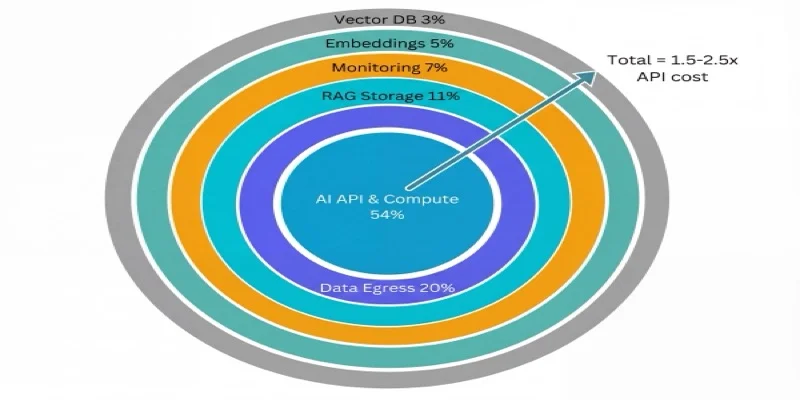
The API cost — the token charges you calculated in the previous section — is often less than half of the total cost of running an AI workload. Here are the five categories that make up the rest.
Key Concepts
Total Cost of Ownership (TCO)
The full cost of an AI system including API charges, data egress, embeddings, vector DB, RAG storage, and monitoring — typically 1.5-2.5x the direct API cost.
Data Egress
Charges for data leaving a cloud provider's network; often the largest hidden AI cost when calling external APIs from cloud-hosted applications.
Embeddings
Vector representations of text used in search and RAG systems, generated via separate API calls with their own token costs that scale with data ingestion volume.
Vector Database
A specialized database storing embeddings for similarity search in RAG systems, with costs split between per-vector storage and per-query operations.
TCO questions appear in two forms: "What are the hidden cost components beyond API charges?" (knowledge) and "Why is this company's bill higher than expected?" (scenario). Know all five categories. Data egress is the most commonly missed and often the largest surprise.